Unlimited email aliases are useful when they match a list you can print and a hop you can prove. They are a marketing distraction when the slide replaces leftover-MX cleanup, a named reply owner, or a dest you already search. MailerZ publishes real caps: ten on Free, then 25, 50, 200, 500, then uncapped on Unlimited. Buy the cap. Do not buy a slogan.

Quick answer
Treat “unlimited aliases” as a capacity question, not a personality. Name the store, the printed local-parts, and the single inbound operator. Keep Gmail or Outlook as the mailbox. Point MX at one forwarder. Delete leftover hosts. Prove inbound from a mailbox that is not the destination. Then count how many names you will actually print this year. That number, not a homepage adjective, picks the plan.
MailerZ Free is one domain, ten aliases, one seat, a 14-day store, send-as Off, SMTP Off, API Off, and unrouted mail held or rejected only. Solo is $40 per year: 5 domains, 25 aliases, 2,500 outgoing. Starter is $8 or $80: 8 domains, 50 aliases. Business is $19 or $190: 25 domains, 200 aliases. Agency is $39 or $390: 100 domains, 500 aliases. Unlimited is $99 monthly or $990 yearly: uncapped domains and aliases, 180-day store, 100,000 outgoing, 300 per hour. Confirm live numbers on MailerZ pricing. Those ceilings are capacity, not an inbox-placement promise.
Catch-all is not unlimited aliases. Random privacy strings on a provider domain are not unlimited custom-domain aliases. A suite mailbox per guessed spelling is not unlimited aliases. Transport still follows IETF RFC 5321 — Simple Mail Transfer Protocol. DNS still follows IETF RFC 1035 — Domain names.
The real decision
Buyers search unlimited aliases after a $0 tool capped them at three names, or after a slide promised “infinite identities.” The useful job is usually smaller: three roles on a brochure, twenty vendor-specific prefixes, or a hundred client zones with a short list each. The fragile job is “we cannot list them, so we need unlimited.” That is catch-all wearing a ceiling.
Agencies copy one habit across the book. One noisy client teaches catch-all as a house default. Capacity on Agency or Unlimited is for more zones and aliases, not for giving up on names. Per-domain lists beat a house religion.
| What you have | What to buy | What to refuse |
|---|---|---|
| Three printed roles | Free inbound, or Solo if send-as | Unlimited because the slide was large |
| A vendor prefix per shop | The cap that fits the printed list | Catch-all instead of names |
| Many client zones, short lists | Agency or Unlimited for domains | One catch-all for the book |
| Cannot print the list | Hold unknowns. Write the list | A bigger ceiling as a substitute |
Prove the names you already print before you pay for a larger alias cap.
Start free — one domainWhat an alias actually is
An alias is a local-part that MailerZ will accept and forward to dests you map. It is not a mailbox login. It is not an IMAP user. It is not a send-as grant. RCPT TO must match a named row or, on paid plans, a catch-all you turned on. Header From on inbound stays the author. Envelope SRS may rewrite MAIL FROM.
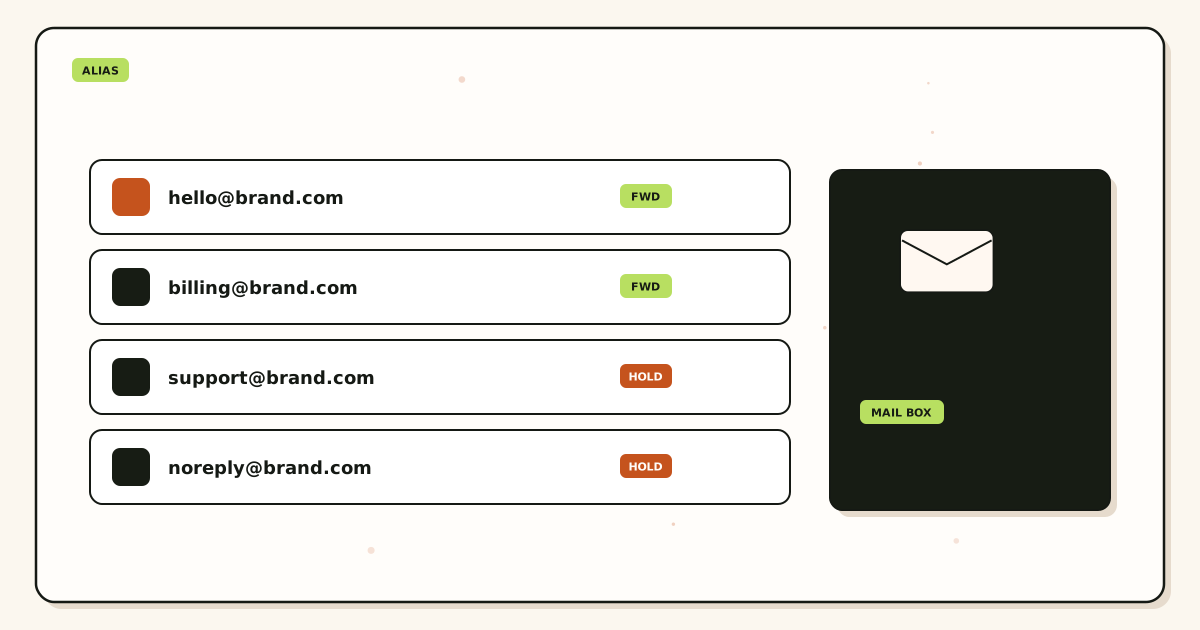
More rows mean more names you can disable one at a time when a vendor leaks. That is the useful feature. More rows do not mean unlinkable identities on the same registrable domain. The domain is still the join key. Unlimited prefixes on one zone are still one operator.
Outbound is a second hop. Paid SMTP allows From identities you created, inside hourly and monthly caps. Unlimited aliases on Unlimited plan do not mean unlimited outgoing. Outgoing is 100,000 per month and 300 per hour on that card. Solo is 2,500 and 20. Creating a hundred inbound rows does not mint a hundred From identities you can blast. Bulk marketing belongs on a bulk platform.
Leftover MX ignores your ceiling. If Google still answers, the harvest and the customers hit the leftover host. History here stays empty. No alias cap, unlimited or otherwise, can store a hop that never arrived.
How to choose a ceiling
Print the public list
Homepage, invoices, job posts, vendor accounts. If you cannot print it, stop. Hold unknowns. Do not shop Unlimited yet.
Prove inbound on that list
Exclusive MX. Unique subjects from another mailbox. Header From and history. Leftover hosts deleted. Help on troubleshooting.
Count names you will print this year
Ten fits Free. Twenty-five fits Solo. Fifty fits Starter. Two hundred fits Business. Five hundred fits Agency. Beyond that, Unlimited. Confirm pricing the day you buy.
Keep catch-all off
Hold unknowns. Promote a leftover when a human used it. Paid forward belongs to a dated cutover, not to “we bought unlimited.”
Decide send-as separately
Free has none. Solo starts send-as. Copy host, port, and TLS together. Catch-all does not mint a From.
Related: aliases and catch-all, features. Field maps live in the docs.
Failure modes and proof
| Symptom | Likely cause | What to check |
|---|---|---|
| Unlimited plan, empty history | Leftover MX. | Public lookup from two resolvers. |
| Inbox is a harvest | Catch-all as “unlimited.” | Hold unknowns. Named list. |
| 550 on send from a new prefix | From never created, or still on Free. | Named identity. Paid send-as. |
| Hit the outgoing cap | Ceiling is aliases, not bulk. | Plan counters. Bulk platform. |
| Cannot disable one leak | No named rows. Catch-all only. | Create names. Kill the leaked one. |
If history is empty, a larger alias cap will not invent hop one. Print MX first.
Open leftover MX troubleshootingMailerZ workflow and product boundary

MailerZ will route the names you create and hold or forward unknowns per plan policy. It will not make prefixes unlinkable. It will not become a privacy-mask product on a provider domain. It will not become a bulk sender because Unlimited includes the word unlimited. Outgoing caps still apply.
MailerZ is not IMAP, not a suite, not an open relay, not an inbox SLA. Unauthorized send is 550. The store windows are 14, 90, or 180 days depending on plan. They are hop evidence, not an archive of every alias you might one day invent.
Plan caps and alternatives
Quote the live pricing page. Free: 10 aliases. Solo $40/year: 25. Starter $8/$80: 50. Business $19/$190: 200. Agency $39/$390: 500. Unlimited $99/$990: uncapped aliases and domains, 180-day store, 100,000 outgoing, 300/hour. Annual Starter, Business, and Agency include two months free versus monthly. Solo is yearly only.
A privacy-mask subscription is correct for per-site random addresses on their domain. It is the wrong buy when customers must write hello@ on a domain you own. A suite mailbox per guessed spelling is the expensive wrong turn. Registrar “unlimited forwarding” is often a thin hop with no history.
Time is still a line item. Leftover MX costs more than Solo. Catch-all noise costs more than Agency. A missing list costs more than Unlimited. Budget the list first.
Worked examples
They bought Unlimited because the competitor slide said infinite
They still had leftover Google MX and three printed names. Unlimited did not see the leftover copies. They cut MX, proved hello@ billing@ and careers@, and could have stayed on Solo. The slide was the distraction.
Catch-all as “unlimited”
The inbox filled with harvest. They could not disable one leak because there were no rows. They turned catch-all off, held unknowns, created the three names they actually printed, and disabled a leftover that a human had used. The ceiling never mattered.
Vendor prefixes that earned the cap
A shopper created a prefix per merchant on their domain, printed the list in a password manager, and disabled leaks one at a time. They outgrew Solo’s twenty-five and moved to Starter’s fifty. That is a useful feature. The domain still correlated them. They knew that.
Agency book with short lists
Forty clients times four roles is 160 aliases and forty domains. That is a Business or Agency domain-and-alias problem, not a catch-all problem. They kept per-zone lists and per-zone SMTP. Unlimited was optional for domain count, not for skipping names.
Write the last change on a sticky note before you open billing. Leftover MX, a missing list, a harvest, or a real prefix count. If the sticky note says leftover MX, stop shopping ceilings. If it says missing list, write the list. If it says harvest, hold unknowns. If it says 40 client zones, count domains first.
Print the public list again after you upgrade. If you still cannot print it, you bought a slogan. Three named aliases on Free are enough to stop printing a personal Gmail on a homepage. Grow the list when a real person used a leftover, not when a harvest guessed admin@.
Send-as does not scale with inbound rows automatically. A hundred aliases and one From you created is a normal paid setup. A hundred From identities you never created will 550. Copy the dashboard pair for the identities you will actually send. Revoke at handover. Do not mail secrets.
Plus addressing on Gmail is not an unlimited-alias plan. you+shop@gmail.com is a dest filter. A custom-domain prefix is a row you can disable without changing Gmail. Do not rank a plus-tag habit as a MailerZ ceiling.
Self-send still lies when you have a thousand aliases. Probe from another mailbox. Unique subject. History. Dest search including spam. Classify is still hop four. Unlimited does not file Primary.
Quarterly leftover MX review still applies on Unlimited. A bigger card does not make split MX safer. Review sooner after a nameserver move or a plugin swap. When this page is closed, the next physical action is a printed list and a probe, not another comparison tab of adjectives.
Legal pages are published separately. MailerZ is not SOC 2, not ISO 27001, not HIPAA. A large alias cap is not a compliance badge. If counsel wants eDiscovery, buy eDiscovery. The store window is hops this layer saw.
Comparisons: Cloudflare Email Routing is inbound routing with its own rules. Privacy-mask products mint random strings on their domain. Suites host mailboxes. Cite their docs. Do not invent feature parity. MailerZ is the delivery layer when you already have Gmail or Outlook and you need named routes you can prove.
What “unlimited” means on this product, exactly
On MailerZ, Unlimited is a plan name. It uncaps domains, aliases, and seats. It lengthens the store to 180 days. It raises outgoing to 100,000 per month and 300 per hour. It still forwards unknown mail when you choose Forward on paid plans. It still holds or rejects unknowns the way you configured. It still refuses unauthorized send with 550. It still does not host IMAP. Confirm those sentences on the live pricing page before you put them in a contract.
On a competitor slide, unlimited often means catch-all, or random strings on their domain, or “we will not charge per alias this month.” Read their docs. Nofollow commercial pages. Do not copy their adjective onto MailerZ Free, which is ten aliases, or onto Solo, which is twenty-five.
Disable, remap, and the reason named rows win
The useful part of a high ceiling is the disable button. When shop-west@ leaks, you kill that row and keep hello@. Catch-all cannot do that without also killing every guess you never wanted. A slogan that only offers catch-all is not a high alias cap. It is a policy you will regret the first scrape.
Remap is the other useful part. Twenty vendor prefixes into one dest Gmail can become twenty prefixes into a new dest when you change jobs. The printed names stay. That is replaceability. Unlimited rows make that easier only if you kept the list. A thousand unnamed leftovers in a hold queue are not a list. They are homework.
Agencies should count domains times names, not “unlimited feels safer.” Forty zones times four roles is a known integer. Put it on Agency or Unlimited because the integer is real. Do not put it on catch-all because the spreadsheet got long. Offboard still means delete MX you own, revoke SMTP, and stop forwarding leftovers into the agency inbox.
If send-as must exist on many prefixes, create the identities you will send, stay inside the hourly cap, and rotate per client. Unlimited outgoing does not exist on this product. The Unlimited plan’s 300 per hour is a stop sign, not a negotiation. A contact form on Solo is a different job from a newsletter. Buy the newsletter platform for the newsletter.
When Free or Solo is the honest ceiling
A personal site that prints hello@, billing@, and press@ needs three named rows. Free holds ten. Solo at $40 per year holds twenty-five and turns send-as on. That is usually enough for a founder who also wants a few vendor prefixes. The distraction is opening Unlimited because a comparison table highlighted the word. Confirm pricing against names you will print this year, not against a competitor adjective.
If you already have leftover Google MX, the ceiling is a costume. Copies that never reach this layer do not consume an alias slot and they do not prove the hop. Cut the leftover. Wait for two public views. Probe the three names. Then decide whether twenty-five is tight. Most people who “need unlimited” on day one still cannot list twelve strings they would put on a business card.
Harvest, hold, and the disable button
Catch-all looks like a high alias cap because every guess arrives. It is the opposite of a list. You cannot disable shop-west@ if shop-west@ was never a row. Hold unknowns on Free, or choose Forward on paid only when you have a reason and a dest that will survive the noise. A scrape will train the dest spam button faster than any plan upgrade will rescue it. Named rows you can kill are the useful feature. A slogan that only offers catch-all is a policy you will regret.
Vendor prefixes earn a higher cap when you can open a password manager and read the list. shop-west@, shop-east@, stripe-prod@ — those are disable targets. Random leftovers sitting in a hold queue are homework, not inventory. Promote a leftover only when a real person used it. Do not promote admin@ because a harvest guessed it. That guess is why hold exists.
Agencies, seats, and the store window
Agency at $39 or $390 is 100 domains and 500 aliases. Unlimited at $99 or $990 uncaps both and lengthens the store to 180 days. Count domains times names before you pick. Forty clients times four roles is 160 aliases and forty domains — a real Agency or Unlimited integer, not a feeling. Seats are dashboard operators, not dest Gmails. Two founders sharing hello@ still need dests, not two extra seats, unless both people must click the MailerZ panel.
The store is hop evidence: 14 days on Free, 90 on paid, 180 on Unlimited. It is not an archive of every alias you might invent later. A large cap does not keep last year’s probes. If counsel wants eDiscovery, buy eDiscovery. MailerZ is not SOC 2. A ceiling is not a compliance badge. Offboard still means delete MX you own, revoke SMTP, and stop pouring leftovers into the agency inbox.
FAQ
- Are unlimited aliases a useful feature or a marketing line?
- A ceiling you can name is useful. A slogan that hides leftover MX or catch-all is a distraction. MailerZ publishes alias caps per plan: ten on Free, twenty-five on Solo, fifty on Starter, two hundred on Business, five hundred on Agency, uncapped on Unlimited. Buy the cap that matches a list you can print.
- Does unlimited aliases mean I should enable catch-all?
- No. Catch-all is a policy on unknowns, not a synonym for a high alias ceiling. Hold unknowns on everyday production. Promote a leftover only when a real person used it. A harvest will guess faster than you can name.
- Does this require a new mailbox?
- No. MailerZ is not IMAP. Gmail or Outlook stays the store. More aliases are more routes into that store, not more hosted logins.
- What should I test before I buy a bigger alias cap?
- Print the public list. Prove inbound on the names you already print. Cut leftover MX. If you cannot print the list, a bigger ceiling will not save you. If leftover MX is live, no ceiling will see that mail.
- When is MailerZ Unlimited the right card?
- When you need uncapped domains and aliases, a 180-day store, and up to 100,000 outgoing per month. Confirm live numbers on pricing. It is not an inbox SLA and not a reason to skip a named list.
- Can I send as every alias I create?
- Only identities you created, on a paid plan, within hourly and monthly outgoing caps. Catch-all does not mint a From. Free has no send-as. Creating inbound rows does not approve outbound.
Key takeaways
- A printed list plus exclusive MX is the useful feature. A slogan is the distraction.
- Free 10, Solo 25, Starter 50, Business 200, Agency 500, Unlimited uncapped. Confirm /pricing.
- Catch-all is not unlimited aliases. Hold unknowns.
- Leftover MX ignores every ceiling.
- Outbound caps are separate. Unlimited aliases ≠ unlimited send.
- More prefixes on one domain are still one join key.
- MailerZ is not IMAP and not an inbox SLA.
- Buy the cap that matches names you will print this year.
Conclusion and next action
Unlimited aliases are useful when you can print the names and prove the hop. They are a distraction when they replace leftover-MX cleanup or a missing list. Start on Free with the names you already print. Upgrade when the list or send-as requires it. Do not buy a slogan.
Print the list first
Start free, create the names you can prove, hold the rest.
Cut leftover MX. Pay for a larger cap only when the list is real.
Review quarterly, or sooner if plan caps or provider DNS guidance change. Author: MailerZ editorial, Secuno LLC.