Email alias ownership tracking is how agencies and small firms survive vacations. An alias without an owner is a hold ticket in three months. Write name, purpose, destination, send-as yes/no, owner, created. MailerZ will not invent that sheet for you. We will hold unknowns on Free so unnamed guesses do not pretend to have owners.
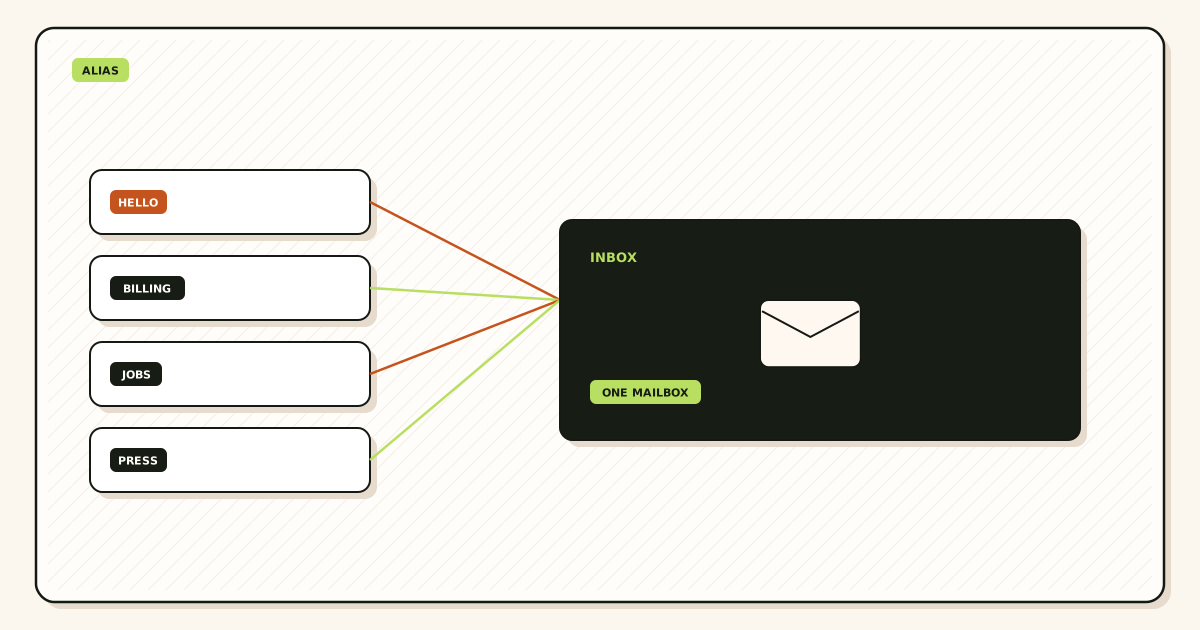
Quick answer for email alias ownership tracking
Ownership is not the MailerZ seat alone. It is the human who notices if mail stops.
Multiple dests need a reply rule in the same row.
Retired aliases stay in the sheet as retired, or someone will recreate them “to be safe.”
Catch-all FORWARD has no per-name owner. That is why it is dangerous.
Authoritative mail transport is still IETF RFC 5321 — Simple Mail Transfer Protocol. features. migration planner. delivery recovery.
Prove the hop with a received copy before you treat email alias ownership tracking as a DNS edit.
Start free — one domainThe real decision
Slack memory is not a register.
Decision: spreadsheet, doc, or the helpdesk CMDB — pick one.
Clients will lie about who reads jobs@. Probe and write reality.
Suites have their own shared-mailbox owners. Still write the public name here.
When this path is enough
- You can staff exclusive MX and named aliases.
- You will keep Header From intact.
- You can probe from another mailbox.
When this is the wrong ticket
- History is empty and leftovers remain.
- You want an inbox placement SLA.
- You plan to rewrite visible From.
Technical mail flow
Create alias → write row → probe → attach hop screenshot.
Change dest → update row → probe again.
Delete alias → mark retired → watch HOLD if someone still writes it.
MX leftovers make ownership look broken when the hop never ran.

Step-by-step decision path
- Inventory leftovers. Screenshot current MX, SPF, DKIM, NS.
- Verify the domain. TXT as the dashboard states.
- Create named aliases first. Do not cut MX onto empty maps.
- Publish one MX set. Delete Google, Microsoft, registrar leftovers.
- Prove from another mailbox. Unique subject. Header From intact.
- Only then send-as if paid. Dashboard SPF/DKIM. Outbound probe.
- Store the proof packet. MX, hop, headers, plan name.

Worked examples
jobs@ dest was an ex-contractor. Six weeks of silence. Sheet would have shown the dest email.
Agency template: five default rows per client. Onboarding faster.
They tracked only aliases, not dests. Gmail renamed. Mail vanished. Dest column matters.
Send-as yes on a name nobody used. Wasted cap headroom. Sheet said unused. They disabled send-as.
Two owners listed, none responsible. They picked one RACI.
If history and public MX disagree, believe MX first.
Open the matching guideFailure modes and proof
| Symptom | Likely cause | Proof |
|---|---|---|
| Empty history | Leftover or cached MX | Two resolvers |
| Unknowns missing | Free HOLD | History hold |
| Header From rewritten | Wrong hop | Received From |
| SMTP 550 send-as | Free or unauthorized From | History line |
| spf=fail hop two | Naive envelope | Return-Path |
| Still spam after clean hop | Destination filters | Not an SLA |
| Self-send clean | Short-circuit | Other mailbox |
| Wrong DNS panel | NS ≠ registrar UI | NS lookup |
MailerZ workflow and product boundary
Secuno LLC operates MailerZ. Site: mailerz.net. App: mail.mailerz.net. Envelope SRS only. Header From, Subject, Date, Message-ID, body, and MIME are never rewritten. Not IMAP. Not an open relay.
What MailerZ does
- Accept MX for verified domains.
- Rewrite envelope MAIL FROM with SRS on the forward.
- Leave Header From and MIME intact.
- Hold unknowns on Free. Optional paid FORWARD.
- Paid SMTP from approved identities. Dashboard SPF, DKIM, and DMARC instructions.
- 550 for unauthorized From. Not an open relay.
What MailerZ does not do
- Guarantee Gmail Primary or any inbox placement rate.
- Host IMAP, Calendar, or a Workspace suite.
- Send-as on Free.
- SOC 2, ISO 27001, HIPAA, review counts, or an uptime SLA. Controls: Security and Trust Center.
Plans: MailerZ pricing. Free $0, 1 domain, 10 aliases, 1 seat, 14-day store, send-as Off, SMTP Off, API Off. Solo $40/year, 5 domains, 25 aliases, 90-day, 2,500 outgoing, 20/hour, send-as On, SMTP On, API On. Starter $8 or $80, 8/50/5, 5,000, 40/hour. Business $19 or $190, 25/200/25, 12,000, 60/hour. Agency $39 or $390, 100/500/50, 20,000, 60/hour. Unlimited is $99/month or $990/year. Annual Starter, Business, and Agency include two months free versus monthly. Solo is yearly only. Alias inventory you can still see lives in Mail Box. Field maps: MailerZ documentation.
Cost, alternatives, and trade-offs
| Approach | You get | You give up |
|---|---|---|
| Exclusive MX + named aliases | Debuggable path | You must delete leftovers |
| Dual MX backup | Feels safe | Coin-flip misses |
| From rewrite | Cosmetic SPF | Trust and DKIM |
| Suite seats | Hosted mailbox | Per-user price |
Field notes
Related: /features, /migration-planner, /delivery-recovery, /pricing.
Do not put SMTP passwords in the ownership sheet.
Export the sheet with the MX screenshot in the same folder.
Quarterly review or after every exit.
Search demand for email alias ownership tracking usually arrives as a screenshot, not a sentence. Ask for the received copy, the public MX set, and the plan name before you change a record. How to Track Who Owns Each Alias and Destination is a workflow, not a checkbox.
Write a one-paragraph policy the team can reuse for email alias ownership tracking. Name the hop (inbound versus outbound), the proof artifact, and the thing you will not do (dual MX, From rewrite, second SPF record). Put the paragraph in the ticket template.
Change control matters more than a clever record. One person owns DNS for this domain. Adding an include, a selector, or a backup MX requires a ticket. Most regressions in email alias ownership tracking are Friday edits without a probe.
Self-send remains invalid for email alias ownership tracking. Gmail can short-circuit. Outlook can look local. Use a mailbox on another provider and a unique subject. If the customer refuses, the ticket stays open.
Leftover MX masquerades as every authentication and spam incident. If history is empty, email alias ownership tracking is the wrong title until two resolvers agree on one product. Delete aspmx, Microsoft, and registrar MX. Wait TTL.
Free HOLD and missing aliases masquerade as outages. History shows the hold. Create the named local-part or accept that unknowns stay. Catch-all FORWARD is paid, optional, and a spam trade-off — not a debugger for email alias ownership tracking.
Paid send-as is a different hop from inbound email alias ownership tracking. Free cannot send. Unauthorized From is 550 / 550 5.7.1. Publishing prettier DNS will not authorize a From the product has not approved.
Destination filters still win after a clean hop. How to Track Who Owns Each Alias and Destination does not include an inbox placement SLA, review counts, or a Primary guarantee. Say that once, early, so the customer stops buying a story you cannot ship.
Proof packet for email alias ownership tracking: public MX from two resolvers, inbound received copy with Header From, Authentication-Results, outbound received copy if they send, plan name, and the SMTP line if anything refused. That packet ends folklore.
Retention is 14 days on Free and 90 on paid. Export headers while they live. email alias ownership tracking arguments without artifacts become myths. The destination inbox is the archive, not the hop store.
Agencies should not blend clients in one email alias ownership tracking thread. One domain, one matrix, one MX screenshot. Agency plan limits are 100 domains, 500 aliases, 50 seats, 20,000 outgoing, 60/hour — still not unlimited, still not an SLA.
Security hygiene: no SMTP passwords in the email alias ownership tracking ticket, no message bodies in chat, no invented SOC 2. Controls live on the Security and Trust Center. Secrets rotate if they leaked.
Related operations stay on real routes: forwarding, send-as, troubleshooting, tools, delivery recovery, docs, pricing. Do not invent a pillar. If email alias ownership tracking is actually leftover MX, say leftover MX.
Refresh cadence is at least quarterly, sooner after a domain transfer, panel change, ESP trial, or dashboard host change. How to Track Who Owns Each Alias and Destination goes stale when the zone changes and the runbook does not.
If two products still share MX after you explained the coin flip, stop adding records. Exclusive MX is a hard stop. email alias ownership tracking cannot be correct on a split path.
If Header From is already rewritten, stop tuning SPF for email alias ownership tracking. Change the hop. MailerZ will not offer a From-replace control. Honest identity is the product.
If the customer wants a suite, sell the suite as Calendar and a hosted mailbox, not as a magic fix for email alias ownership tracking. Workspace and Microsoft 365 are different architectures with their own filters and their own 550s.
Hourly and monthly send-as ceilings (disabled/2,500/5,000/12,000/20,000 outgoing; 20/40/60/60 per hour by plan) produce refuses that look like email alias ownership tracking outages. Read counters before you republish DKIM.
Null MX plus a real MX is another lie. Remove the lone-dot refuse if you intend to receive. Empty inbound plus a pretty email alias ownership tracking essay is still a refuse-all.
After you change anything, wait TTL, probe from another mailbox, and store the new received source next to the MX screenshot. How to Track Who Owns Each Alias and Destination is done when proof exists, not when the panel is green.
Field story 1 for email alias ownership tracking: jobs@ dest was an ex-contractor. Six weeks of silence. Sheet would have shown the dest email. Keep that story in the runbook so the next person does not reopen How to Track Who Owns Each Alias and Destination from zero.
Field story 2 for email alias ownership tracking: Agency template: five default rows per client. Onboarding faster. Keep that story in the runbook so the next person does not reopen How to Track Who Owns Each Alias and Destination from zero.
Field story 3 for email alias ownership tracking: They tracked only aliases, not dests. Gmail renamed. Mail vanished. Dest column matters. Keep that story in the runbook so the next person does not reopen How to Track Who Owns Each Alias and Destination from zero.
Field story 4 for email alias ownership tracking: Send-as yes on a name nobody used. Wasted cap headroom. Sheet said unused. They disabled send-as. Keep that story in the runbook so the next person does not reopen How to Track Who Owns Each Alias and Destination from zero.
Field story 5 for email alias ownership tracking: Two owners listed, none responsible. They picked one RACI. Keep that story in the runbook so the next person does not reopen How to Track Who Owns Each Alias and Destination from zero.
For email alias ownership tracking, symptom “Empty history” usually means Leftover or cached MX. Isolate it with Two resolvers. Do not stack a second change until that proof exists.
For email alias ownership tracking, symptom “Unknowns missing” usually means Free HOLD. Isolate it with History hold. Do not stack a second change until that proof exists.
For email alias ownership tracking, symptom “Header From rewritten” usually means Wrong hop. Isolate it with Received From. Do not stack a second change until that proof exists.
For email alias ownership tracking, symptom “SMTP 550 send-as” usually means Free or unauthorized From. Isolate it with History line. Do not stack a second change until that proof exists.
For email alias ownership tracking, symptom “spf=fail hop two” usually means Naive envelope. Isolate it with Return-Path. Do not stack a second change until that proof exists.
For email alias ownership tracking, symptom “Still spam after clean hop” usually means Destination filters. Isolate it with Not an SLA. Do not stack a second change until that proof exists.
For email alias ownership tracking, symptom “Self-send clean” usually means Short-circuit. Isolate it with Other mailbox. Do not stack a second change until that proof exists.
For email alias ownership tracking, symptom “Wrong DNS panel” usually means NS ≠ registrar UI. Isolate it with NS lookup. Do not stack a second change until that proof exists.
Setup step “Inventory leftovers.” for email alias ownership tracking: Screenshot current MX, SPF, DKIM, NS. Skip it and How to Track Who Owns Each Alias and Destination turns into a second ticket next week. Do the step, store the artifact, then continue.
Setup step “Verify the domain.” for email alias ownership tracking: TXT as the dashboard states. Skip it and How to Track Who Owns Each Alias and Destination turns into a second ticket next week. Do the step, store the artifact, then continue.
Setup step “Create named aliases first.” for email alias ownership tracking: Do not cut MX onto empty maps. Skip it and How to Track Who Owns Each Alias and Destination turns into a second ticket next week. Do the step, store the artifact, then continue.
Setup step “Publish one MX set.” for email alias ownership tracking: Delete Google, Microsoft, registrar leftovers. Skip it and How to Track Who Owns Each Alias and Destination turns into a second ticket next week. Do the step, store the artifact, then continue.
Setup step “Prove from another mailbox.” for email alias ownership tracking: Unique subject. Header From intact. Skip it and How to Track Who Owns Each Alias and Destination turns into a second ticket next week. Do the step, store the artifact, then continue.
Setup step “Only then send-as if paid.” for email alias ownership tracking: Dashboard SPF/DKIM. Outbound probe. Skip it and How to Track Who Owns Each Alias and Destination turns into a second ticket next week. Do the step, store the artifact, then continue.
Setup step “Store the proof packet.” for email alias ownership tracking: MX, hop, headers, plan name. Skip it and How to Track Who Owns Each Alias and Destination turns into a second ticket next week. Do the step, store the artifact, then continue.
Trade-off on email alias ownership tracking: choosing Exclusive MX + named aliases gets you Debuggable path and gives up You must delete leftovers. Write that exchange on the quote so nobody pretends it is free.
Trade-off on email alias ownership tracking: choosing Dual MX backup gets you Feels safe and gives up Coin-flip misses. Write that exchange on the quote so nobody pretends it is free.
Trade-off on email alias ownership tracking: choosing From rewrite gets you Cosmetic SPF and gives up Trust and DKIM. Write that exchange on the quote so nobody pretends it is free.
Trade-off on email alias ownership tracking: choosing Suite seats gets you Hosted mailbox and gives up Per-user price. Write that exchange on the quote so nobody pretends it is free.
How to Track Who Owns Each Alias and Destination is enough when You can staff exclusive MX and named aliases. If that condition is false, stop implementing email alias ownership tracking and reopen the decision.
How to Track Who Owns Each Alias and Destination is enough when You will keep Header From intact. If that condition is false, stop implementing email alias ownership tracking and reopen the decision.
How to Track Who Owns Each Alias and Destination is enough when You can probe from another mailbox. If that condition is false, stop implementing email alias ownership tracking and reopen the decision.
How to Track Who Owns Each Alias and Destination is the wrong ticket when History is empty and leftovers remain. Name the correct system instead of forcing email alias ownership tracking to cover it.
How to Track Who Owns Each Alias and Destination is the wrong ticket when You want an inbox placement SLA. Name the correct system instead of forcing email alias ownership tracking to cover it.
How to Track Who Owns Each Alias and Destination is the wrong ticket when You plan to rewrite visible From. Name the correct system instead of forcing email alias ownership tracking to cover it.
Write email alias ownership tracking in the subject line of the ticket and the layer in the first sentence. If the layer is leftover MX, say leftover MX. If the layer is HOLD, say HOLD. If the layer is a destination 550, paste the text. How to Track Who Owns Each Alias and Destination stays short when the first sentence is honest.
Keep a standing calendar note for email alias ownership tracking: monthly external probe, leftover MX lookup, and a glance at send-as counters if you are paid. Five minutes. The outage you avoid is the Friday dual-MX restore.
When two vendors disagree about email alias ownership tracking, believe artifacts: two resolvers, one received copy, one history row. Do not believe the prettier admin center. Registrar dots lie. Composer UIs lie. Self-send lies.
Teach the next hire the MailerZ split before they touch email alias ownership tracking: envelope may change, Header From must not, Free cannot send, unknowns HOLD, leftover MX is a hard stop, no inbox SLA, no SOC 2 sticker. That speech prevents a class of tickets.
If email alias ownership tracking appears in an RFP, answer with published caps and hop evidence. Decline inbox-rate clauses. Decline fake certifications. Point at pricing and the Security and Trust Center. How to Track Who Owns Each Alias and Destination is not a place to invent enterprise theater.
Export while the 14- or 90-day window still has the email alias ownership tracking hop. Future-you will not remember the SMTP sentence. The destination mailbox remains the archive. We will not grow the store because a blog asked.
Do not bundle unrelated edits with email alias ownership tracking. Rotating SMTP while republishing MX while enabling FORWARD is how you lose the ability to name the failure. One change, one probe, one stored copy.
If you need a suite, buy a suite for Calendar and a hosted mailbox. If you need a hop, buy a hop. How to Track Who Owns Each Alias and Destination does not become Exchange because a quote stacked seats next to aliases.
FAQ
What is the safest way to handle email alias ownership tracking?
No alias without a row. No destination without a human. Review quarterly. Revoke dests on exit day. HOLD what you cannot name.
Does this require a new mailbox?
No. MailerZ is Mail Box portal webmail (Inbox, Sent, New email). It is not IMAP or POP. Gmail or Outlook stays the store. Buy a suite seat only if you need Calendar and a hosted mailbox, not because this workflow failed.
Will it work with Gmail or Outlook?
Yes as a destination inbox when MX is exclusive and the alias exists. Header From stays the original sender on inbound. Paid send-as is a separate hop. Free has no send-as. Self-send from the same Gmail can hide failures.
What DNS records are involved?
Inbound: verification TXT, one MailerZ MX set, leftover MX removed. Outbound send-as: one SPF TXT, DKIM, and DMARC as the dashboard states. Two MX products split mail. Two SPF records permerror.
What should I test before production?
Prove inbound from another mailbox with a unique subject. Confirm Header From and history. If you send, prove paid SMTP to a third-party mailbox. Wait TTL after DNS deletes. Composer UI is not proof.
Key takeaways
- Exclusive MX is a hard stop.
- Header From stays the original sender.
- SRS is envelope-only.
- Free holds unknowns and cannot send-as.
- 550 means read the text.
- Self-send lies.
- No inbox SLA.
- 14- or 90-day store is not an archive.
- MailerZ is not IMAP.
- No SOC 2, ISO, or HIPAA claims.
Conclusion and next action
If nobody owns the name, nobody will notice it die.
Next action: dump aliases, add owner and dest columns, fill blanks or delete names.
Ready to write the register
Start free, create three named rows, leave the rest held.
Paid is how the register grows without becoming a cannon.
Review quarterly, or sooner if DNS hosts or dashboard instructions change. Author: MailerZ editorial, Secuno LLC.