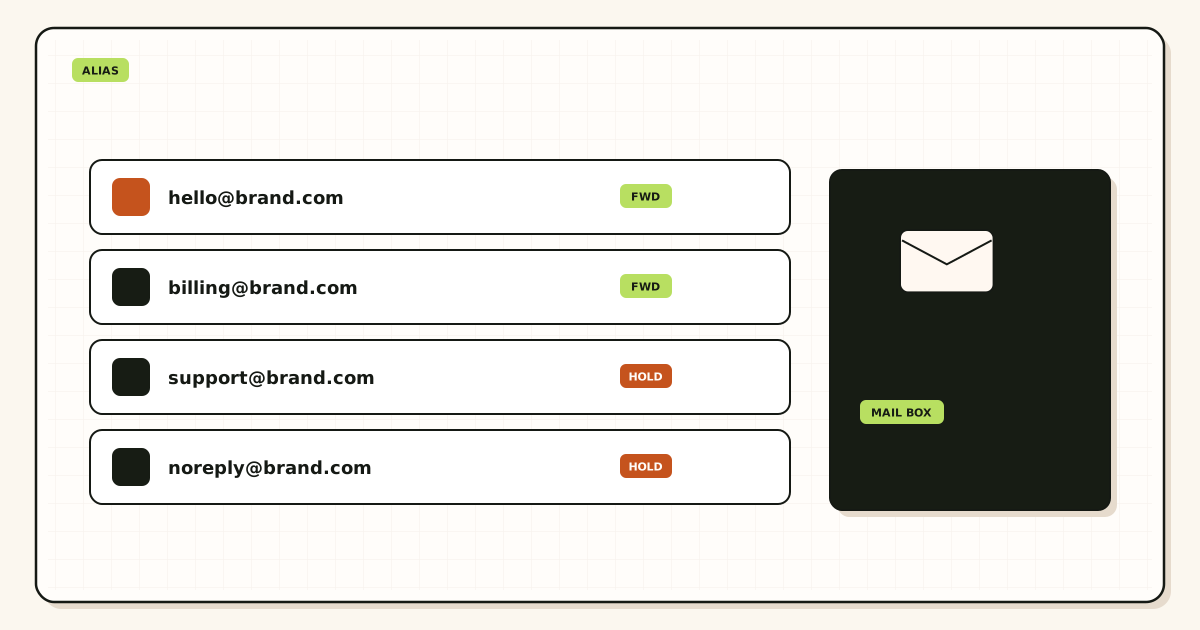
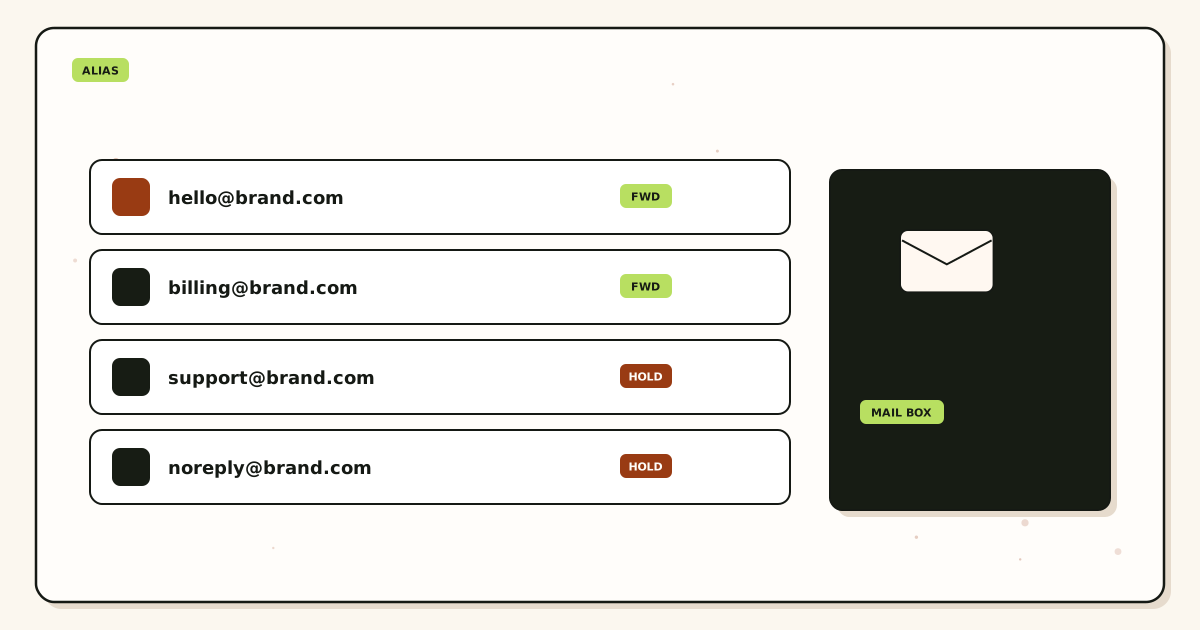
An agency email alias naming standard is a shared list of public nouns—hello, support, billing—created as named aliases on every client zone, with destinations that belong to that client only. It is not one catch-all for the fleet, not one MX screenshot pasted into ten panels, and not leftover registrar mail on Client B while Client A looks clean. Exclusive MX per zone. HOLD unknowns. Probe each printed string. Count aliases against the plan before you invent a vertical extra. The nouns can be identical. The destinations, MX owners, and SMTP users cannot.

Quick answer for agency email alias naming standard
Write the noun list once. Intake which extras a vertical needs. Create those aliases on the client domain with that client’s Gmail destinations. Cut exclusive MailerZ MX on that zone only. Product path: features, migration planner, delivery recovery. MX is IETF RFC 5321 — Simple Mail Transfer Protocol. Names are IETF RFC 1035 — Domain names. Quote ImprovMX pricing if you compare hops—do not copy their limits onto ours.
Confirm MailerZ pricing. Free is one domain and ten aliases. Solo is $40 per year. Starter is $8 or $80. Business is $19 or $190. Agency is $39 or $390. A ten-client noun list will not fit Free. No inbox SLA. Not SOC 2. Not ISO 27001. Not HIPAA.
Helpful ops pages name the zone: people-first content. A page that says “we set up email” without naming which zone was cut is a brochure, not a runbook.
Personal naming is a different job. Founders who want you@, shop-vendor@, and bills@ should read the personal alias naming article. Agencies who want hello@ on every client zone stay here. Do not mix the two vocabularies on one ticket.
The user problem and the decision criteria
Agencies invent hello@ on one client, contact@ on the next, and info@ on the third. Night operators then paste the wrong MX set because the tickets look alike. The useful standard is a short noun list plus a per-zone sheet. The useless standard is “we always catch-all.” Catch-all is a policy for unknown local-parts on one zone. It is not a naming system, and it is not a fleet default.
The second failure is destination reuse. An intern copies last month’s Gmail into this month’s hello@ because the noun matches. The internet does not care that both strings say hello. The hop delivers to whoever you mapped. Client B’s customers then land in Client A’s inbox. That is not a DNS problem. That is a sheet problem.
The third failure is leftover MX on one zone while the rest of the fleet looks green. Self-send from the agency Gmail to Client A’s hello@ can succeed because Gmail short-circuits. Client B still has Namecheap Private Email or parking MX next to MailerZ. Foreign senders split. You report “the standard is live.” Half the fleet is not.
| Question | If yes | If no |
|---|---|---|
| Is the noun on the printed list? | Create it on this zone. | HOLD. Do not invent at launch. |
| Is the destination this client’s Gmail? | Map it. | You copied another client. |
| Is MX exclusive on this zone? | You can probe. | Leftover MX. Stop the cut. |
| Will the fleet exceed alias caps? | Quote Agency or collapse extras. | Still count before intake promises. |
| One catch-all for all clients? | That is not a standard. | HOLD unknown per zone. |
| Does the screenshot filename include the zone? | Operators can paste safely. | Treat the file as untrusted. |
Technical mail flow
Each client zone has its own MX owner. Senders resolve that zone only. A standard noun on Client A never reaches Client B. Copying Client A’s MailerZ hosts onto Client B’s leftover Google row is leftover MX, not a rollout. IETF RFC 5321 — Simple Mail Transfer Protocol describes how a sender picks an MX set for one name. It does not merge two clients because the local-part matches.
Envelope MAIL FROM is rewritten with SRS on the hop. Header From stays the original sender. That is why destination Gmail can still show the real person. It is also why a forwarded message is not “from MailerZ” in the way operators sometimes describe it. The hop is MailerZ. The identity in the header is the sender. Do not train clients that we rewrote From. We did not.
Self-send from the agency Gmail to a client hello@ can hide a leftover. Foreign probes per zone are the gate. Two public resolvers should list the same exclusive MailerZ hosts. If one resolver still shows Google or the registrar, the cut is not done. Do not proceed to the next client.
When a client later sends as the domain, SPF, DKIM, and DMARC belong to that zone. IETF RFC 7208 — Sender Policy Framework (SPF), IETF RFC 6376 — DomainKeys Identified Mail (DKIM), and IETF RFC 7489 — Domain-based Message Authentication, Reporting, and Conformance (DMARC) are per-name records. Pasting Client A’s include into Client B’s TXT is another flavor of screenshot reuse. Outbound is a second ticket. Do not mix 550 5.7.1 into a leftover-MX thread.
Step-by-step setup and decision path
Publish the noun list in the brand guide
hello, support, billing, plus optional careers or security. Short. The list lives in one place operators can open without asking Slack.
Intake destinations per noun per zone
Filename the sheet with the zone. Do not reuse last month’s Gmail. If two founders share hello@, write both destinations and who replies.
Build aliases while old MX stays exclusive
Config parallel is safe. Dual MX is not. Maps can exist before the cut. Do not publish MailerZ MX beside Google “just to be safe.”
Cut one zone
MailerZ MX only. Delete leftovers. Two resolvers. If the registrar email product republishes, delete again and write that on the sheet.
Foreign-probe every printed noun
Unique subjects. History 250. Destination search. A 250 with an empty inbox is HOLD, a filter, or the wrong Gmail—see delivery recovery.
Re-query after the next website save
Registrar email republishes. Per zone. Per Monday after launch. Then offboard deletes the hop you sold when the client leaves.
Failure modes and proof
Proof is a noun list, a per-zone sheet, exclusive listings, and probes. Client A can be Agency-ready while Client B is still leftover MX. Do not report “the fleet is green.” Report the zone you just probed.
| What you see | Likely cause | Proof |
|---|---|---|
| Client B mail in Client A Gmail | Copied destinations | Sheet zone mismatch |
| Some senders still hit Google | Leftover MX on that zone | Second resolver |
| Fourth noun missing on Free | Cap | Quote a paid plan |
| Spam to random words | Fleet catch-all FORWARD | HOLD unknown |
| Wrong MX on Client C | Pasted screenshot | Filename missing the zone |
| 250 empty inbox | Filter or HOLD typo | Recovery |
| hello@ works, billing@ bounces | Noun never created | Alias list vs printed list |
| 550 5.7.1 on send-as | Free or unmapped From | Plan and alias, not leftover MX |
IPv6 AAAA failures after exclusive names exist are host problems, not naming problems. Do not add leftover MX to “fix” a destination that 4xxs. That splits senders again. Keep the exclusive set. Open a recovery ticket.
MailerZ workflow and product boundary
Inbound MX plus authenticated SMTP. Envelope SRS. Header From never rewritten. Not IMAP. Not an open relay. Unhosted send is 550 5.7.1. Features describe routing. They do not invent nouns. Paid plans buy domains and aliases, not a bake-off with leftover MX.
Free: 1 domain, 10 aliases, 14-day store, send-as disabled, SMTP and API disabled. Solo $40/yr. Starter $8/$80. Business $19/$190. Agency $39/$390. Confirm pricing. Seats are operators of the map, not mailbox seats. No inbox SLA. No SOC 2.
HOLD is the safe unknown policy on Free and a sane fleet default. FORWARD catch-all is a paid choice per zone after someone agrees to staff the noise. Putting FORWARD on every client because “agencies need catch-all” is how you inherit every typo and every harvested string. See aliases and catch-all.
Send-as is a second ticket per zone. Free has no send-as. Mixing 550 5.7.1 into a fleet leftover-MX thread keeps both jobs open. When a client needs to reply as hello@, map From, pay the plan that includes send-as, and copy dashboard SMTP for that client only. Shared SMTP across clients is the next article. Do not put one password on the noun list.
Cost, alternatives, and trade-offs
Time is a line item. A one-page noun list costs less than a quarter of mixed leftovers. Leftover MX on one client costs more than Agency. Workspace seats per noun are a suite purchase. Quote Google live. Do not pretend MailerZ is Calendar.
| Choice | What you get | What you give up |
|---|---|---|
| Short noun list + Agency | A rememberable fleet | Per-client poetry |
| Unique nouns per client | Brand flavor | Night-operator memory |
| Workspace seat per noun | A suite. Quote Google live | The Gmail they already use |
| ImprovMX for the fleet | Their cards. Quote live | Our HOLD default if that was the job |
| One catch-all, no nouns | Guesses land somewhere | A standard anyone can staff |
If a client already bought Workspace, do not also publish MailerZ MX. That is leftover MX with extra invoices. The standard applies only to zones you actually own as the inbound hop. Zones that stay on the suite stay off the noun-list rollout.
The shared noun list
Default: hello, support, billing. Add careers or security only if someone will staff them. Do not add info, contact, office, team, and mail as synonyms. That is five aliases for one job. Operators then guess which one is printed on the site. Printers then print two. You then create both. The list grows without a decision.
Vertical extras (reservations, admissions, press) go on an appendix, not the default. Intake must say yes. Otherwise HOLD. A restaurant that never answers reservations@ should not print it. A school that staffs admissions@ should add it before the cut, not after the first bounce.
Hyphens and case: lowercase, no plus tags on printed client strings. Plus is a Gmail filter, not a brand guide. IETF RFC 5233 — Sieve Email Filtering: Subaddress Extension describes subaddressing. Clients who want hello+stripe@ can do that in Gmail after the hop. Do not print plus tags on the website. They leak, they look unfinished, and they are not the standard.
Do not print the agency domain as the client’s hello@. The internet remembers the client zone. Using studio@youragency.com as the public string for a law firm teaches senders the wrong name. The alias exists on the client zone. The destination can be the agency Gmail if the contract says you staff it. Those are different facts.
Role addresses are nouns, not people. When an employee leaves, remap the destination. Do not rename hello@ to jordan@ because Jordan answered it. Person names belong on personal domains or on a suite. See how you reassign a role address when someone leaves—same idea, fleet scale.
Per-zone sheets
Columns: zone, nameservers, noun, destination, SMTP user if paid send-as, cut date, probe subjects, close date for old MX drain. Filename with the zone and the date. A sheet named “email setup.xlsx” is how Client C inherits Client A’s MX hosts.
SMTP credentials are per client. Shared SMTP across clients is a later article. Do not put one password on the noun list. If two operators need send-as on the same zone, they share that zone’s user, not the fleet user.
Destinations can be two Gmails for two founders on hello@. That is one hop, two stores. Write who replies. Dual destination is not dual MX. Dual MX is leftover. Dual destination is a map.
Nameserver column exists because theater zones waste days. If the panel you edited is not the zone the public resolver uses, exclusive MX in that panel does nothing. Confirm NS before you cut. IETF RFC 1035 — Domain names is the name system. Your registrar UI is not always the apex the world sees.
Intake that night operators can run
The intake form is the standard made operational. Client legal name. Zone. Who owns the registrar. Who can delete leftover MX. Destination Gmails per noun. Whether send-as is in scope. Whether any extra nouns are staffed. Whether the site currently prints contact@ or info@ that must be redirected or aliased.
If the site prints a noun that is not on the list, you have two honest options: add the noun, or change the site. The dishonest option is catch-all FORWARD so both work. That trains the next designer to invent a fourth string.
Night operators should be able to open the noun list, open the sheet, and refuse a cut if the destination column is blank. “We’ll map it after MX” is how mail lands in HOLD or the wrong store on Saturday. Maps first. Exclusive MX second. Probe third.
Two-factor on destinations. HOLD review on Monday after launch. Re-query after website saves. Registrar “email” products love to republish MX when someone clicks a marketing tile. Write that risk on the sheet. Namecheap-specific republish is covered in the DNS provider articles. The naming standard still applies: after republish, the nouns are still correct and the MX is not.
Capacity math before extras
Three nouns times one zone is Free if you also have no extras. Three nouns times ten zones is thirty aliases and ten domains. That is not Free. That is not Solo. Count before the sales deck promises “we’ll add careers and press.” Agency is $39 or $390 with 100 domains and 500 aliases. Confirm pricing. Limits are not an inbox-placement SLA.
Seats are operators, not mailboxes. A five-person agency does not need five mailbox seats to run a noun list. They need seats to log into the map. Do not sell Workspace math as MailerZ math.
Outgoing caps matter when send-as is in scope. Free has send-as, SMTP, and API disabled. Agency has 20,000 outgoing and 60 per hour. A fleet that blasts “test” from every hello@ on Friday will burn the cap and look like a campaign. One foreign probe per noun per zone is the test. Capacity planning for send volume is a later article. Naming does not excuse a loop.
Store windows matter when a hop fails. Free stores 14 days. Paid stores 90. If you HOLD unknowns, someone must review HOLD. A standard that creates billing@ and then never staffs it fills HOLD with invoices. That is an intake failure, not a product failure.
Screenshots that name the zone
Filename: client-zone-mx-exclusive-2026-04-11.png. Not mx.png. Not final-final.png. The zone string in the filename is the control that stops paste errors. If the file cannot name the zone, do not send it in Slack.
The screenshot shows the MX set only. It does not show another client’s TXT. It does not show a mixed Google row. If the panel still lists a leftover, the screenshot is evidence of an incomplete cut, not a trophy.
Rollback is the dated exclusive screenshot for that zone. If someone republishes leftover MX, you restore the exclusive set from the file that names the zone. You do not restore “whatever we used last month.” Last month may have been a different client.
Offboard without leftover nouns
When a client leaves, remap or delete aliases after they have an exclusive new owner—or they accept bounce. Leaving MailerZ MX beside their new Google is leftover MX with your hostname in it. That is still leftover MX. Your brand is now in their split.
Delete the sheet row. Rotate any SMTP user they had. Do not leave security@ mapped to an agency intern. Do not keep hello@ “for the portfolio” on a departed zone. Night operators who do that are running someone else’s mail.
Registrar republish after they take DNS back is their leftover. Your job is a resolver listing that no longer names you, or a written accept of bounce. Two resolvers. Same as launch, in reverse.
If a second operator needs the order, send this page plus leftover MX troubleshooting. Noun list. Per-zone sheet. Exclusive cut. Probe. Offboard deletes the hop you sold.
Paid Agency does not merge zones. It buys capacity. One inbound owner per zone. Always. The artifacts that close an agency email alias naming standard are a published noun list, per-zone sheets, exclusive resolver listings, and probes. Everything else is improvisation that looks like a process.
Review the noun list when a vertical changes or a client offboards, and quarterly otherwise. If hello@ became contact@ on three sites, either update the sites or update the list. Do not let both live without a written decision.
A noun list is not an Agency plan
Agency at $39 or $390 buys 100 domains and 500 aliases. It does not invent hello@ for a client who printed contact@. The noun list is the standard: which local-parts you create on every new zone, which you refuse, and which you promote only after a real person used them. Ten names on Free is enough to prove one zone. Do not copy the whole Agency ceiling onto a first-time client “in case.”
Per-zone sheets beat a shared catch-all. Client A’s support@ is not Client B’s support@. Same noun, different dest, different offboard. Leftover MX on one client does not excuse a dual MX “backup” on another. Exclusive cut, then probe. Confirm MailerZ pricing when the fleet count is the reason to move cards, not when a naming argument got long. A noun you cannot pronounce on a sales call does not belong on the standard list. Refuse plus-tag folklore as a client standard.
Night operators who invent a one-off local-part on a client zone break the standard. Add the noun to the list or refuse the request. A one-off becomes next quarter’s undocumented harvest.
FAQ
What is the safest way to handle agency email alias naming standard?
Publish one noun list—hello, support, billing, and any vertical extras you will actually staff—then create those named aliases on each client zone with that client’s destinations. Exclusive MX per zone. HOLD unknowns. Probe each public string from a mailbox that is not the destination. Do not copy MX hostnames between clients. Do not use one catch-all for the fleet.
Does this require a new mailbox?
No. Each alias lands in the Gmail or Outlook the client already uses. MailerZ is not IMAP and is not a hosted mailbox. Buy a suite seat only if that client needs folders, Calendar, or a hold product on the domain itself.
Will it work with Gmail or Outlook?
Inbound works when that zone’s MX is exclusive and the alias exists. Self-send from the agency Gmail can hide leftover registrar MX on one client while others look fine. Free has no send-as. Agency is $39 or $390 when the fleet needs more domains. Confirm live pricing.
What DNS records are involved?
Per zone: verification TXT, one MailerZ MX set, leftovers deleted. SPF, DKIM, and DMARC when that client sends. Two clients never share one MX screenshot. See RFC 5321 and RFC 1035.
What should I test before production?
Intake the noun list. Build maps while old MX stays exclusive. Cut one zone. Query two resolvers. Foreign-probe every printed string. Repeat per client. Do not batch-cut ten zones on one Friday.
Key takeaways
- Agency email alias naming standard: shared nouns, per-zone destinations.
- HOLD unknowns. Fleet catch-all is not a standard.
- Exclusive MX per zone. Do not paste screenshots across clients.
- Intake extras. Do not invent nouns at launch.
- Probe every printed string on that zone from a foreign mailbox.
- Offboard remaps and deletes. Leftover MX is still leftover MX.
- Agency $39/$390 when the fleet needs capacity. Confirm /pricing.
- Not IMAP. Not SOC 2. Not an inbox SLA.
Conclusion and next action
If you want a standard across client domains, print a short noun list, sheet each zone, cut exclusive MX, and probe. MailerZ can map names it has. It cannot remember which Gmail belongs to which client if you paste last month’s row. Start free on one client zone, Agency when the fleet is real.
Ready to standardize one zone
Start free with one client domain and the noun list.
Inbound on Free. Agency when the fleet grows. Sign in if the domain is already there.
Review when the noun list or a client offboards, and quarterly otherwise. Author: MailerZ editorial, Secuno LLC.