The way to route unknown email addresses without flooding your inbox is to treat unmatched local-parts as a policy you can watch, not as a vacuum. Hold unknowns on Free. Review the store. Promote a real customer typo to a named alias. Enable paid catch-all forward only for a dated window. One MX set. Leftover hosts still split mail you will never see in that review.

Quick answer for route unknown email addresses
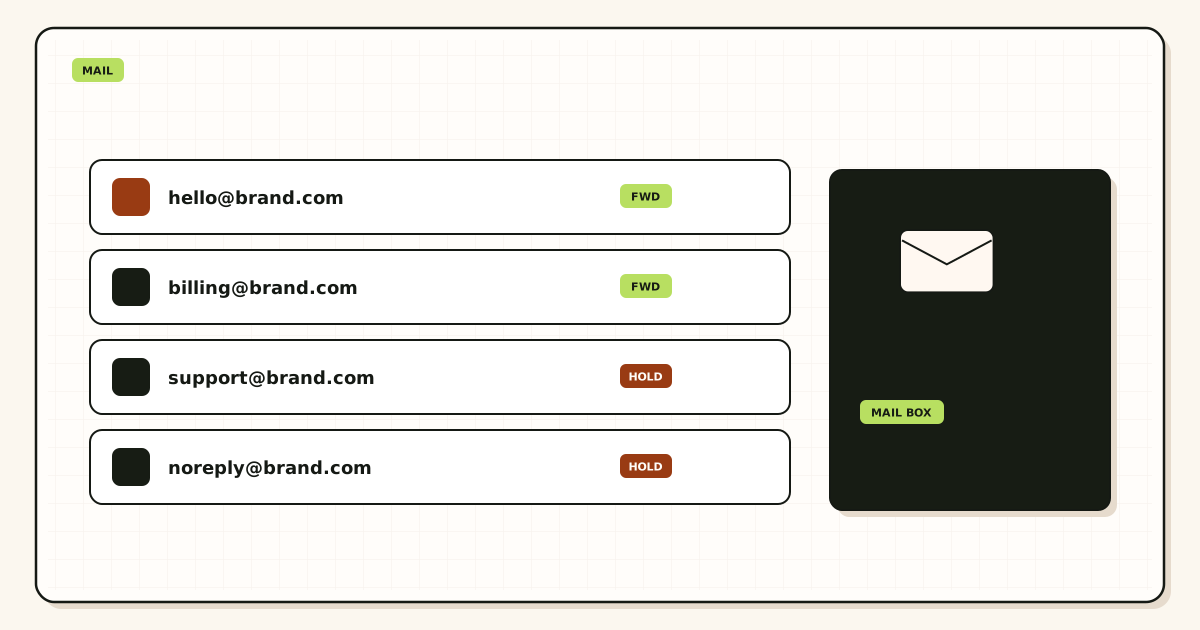
Route unknown email addresses by refusing to make every guessed string a live hop into Gmail. MailerZ Free holds unknown recipients. That is the safest everyday setting for a public domain. You still receive hello@ and billing@ when those names exist. You do not ingest admin@, first-name scrapes, and last year’s intern.
A route unknown email addresses guide that says “just enable catch-all” is selling noise. Catch-all forward can save a customer who still writes support-old@ during a migration. It should have an end date. Each leftover that matters becomes a named alias. Then you turn forward off or leave hold as the default.
Setup is the same MX story as every other MailerZ article because leftover MX is how unknowns disappear. If Google still answers some senders, your hold queue is incomplete. Delete leftover hosts. Probe from another mailbox. Then open the store and look at what actually arrived unmatched.
Do not confuse unknown routing with plus addressing. A plus tag is a subaddress on a mailbox that implements it. An unmatched local-part on your domain is either held, forwarded, or rejected. MailerZ will not strip +secret the way Gmail does on @gmail.com.
MailerZ Free is one domain, ten aliases, one seat, a 14-day store, send-as disabled, SMTP and API disabled, and unrouted mail held or rejected only. Solo is $40 per year only. Starter is $8 monthly or $80 yearly. Business is $19 or $190. Agency is $39 or $390. Unlimited is $99/month or $990/year. Confirm numbers on MailerZ pricing. Limits are not an inbox-placement promise.
route unknown email addresses guide: the real decision
The inbox flood starts as kindness. Someone says we might miss a typo. A week later the same inbox holds newsletters sent to info@, partnership spam sent to team@, and a password-reset for a service you never created. Kindness without a review habit is a spam pipe.
Agencies copy one catch-all habit across client domains. One noisy client teaches the operator that hold is “broken” because the queue is long. The queue is working. The naming list is missing. Print the roles. Leave unknowns held.
Developers sometimes point a wildcard at a ticket system. That can be valid inside a host you control. On a public marketing domain it trains the world that every string works. Tickets become a DDoS of guessed names. Use a dedicated subdomain with a documented pattern if you must automate, and keep the apex quiet.
Decision criteria: can you name the public addresses. Do you have time to review a hold queue. Is this a two-week migration or a forever policy. If forever, you want named aliases and hold, not forward.
| Policy | What arrives in Gmail | When it is justified |
|---|---|---|
| Named aliases only + hold | Only printed names | Everyday production |
| Paid catch-all forward, dated | Everything, including scrapes | Short migration window |
| Reject unknown | Nothing unmatched | When you can lose typos |
| Leftover MX still live | A random subset | Never. Cut the leftover. |
Prove the hop on one domain before you print a new address on a invoice or a form.
Start free — one domainTechnical mail flow for route unknown email addresses
The sending server offers RCPT TO. If the local-part matches an alias, MailerZ forwards to the destination. If it does not, Free holds. Paid catch-all forward, when enabled, sends the leftover to the destination you chose for unknowns. Rejection is a 5xx the sender can see. Hold is not a silent black hole you should ignore; it is a store you open.
Header From on a held or forwarded unknown is still the original author. SRS may rewrite the envelope return path. That does not make the leftover string a legitimate send-as identity. You cannot send as a name you never approved. Unauthorized send is 550.
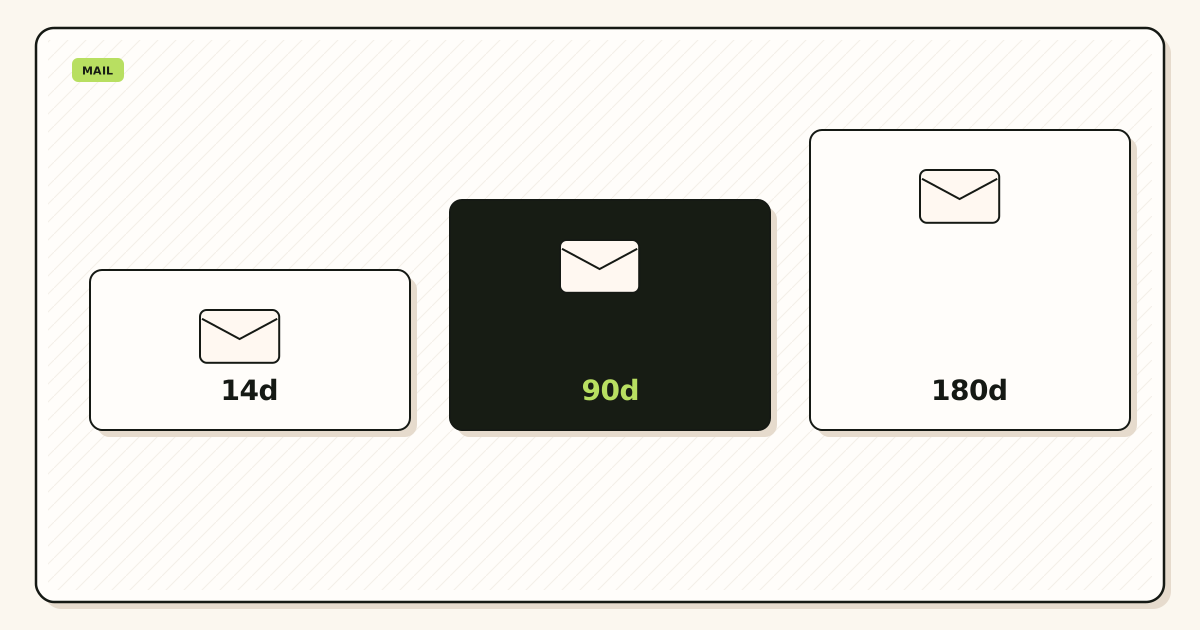
Delivery history matters more here than on a quiet named-only domain. You need to see whether a customer typo landed in hold or vanished at leftover MX. Recovery windows are 14 days on Free and 90 days on paid. They are not an archive product.
Multiple destinations for one unknown policy sound tidy and usually hurt. Two inboxes get the same scrape. Two people mark spam. One real typo is read twice and answered twice. Prefer one review inbox for hold, then a named alias to the owner once the string is real.
Transport still follows IETF RFC 5321 — Simple Mail Transfer Protocol. Envelope commands are not the header block people see. MailerZ may rewrite only the envelope return path with Sender Rewriting Scheme. MailerZ is a product of Secuno LLC. It is inbound MX plus authenticated SMTP. Envelope SRS only. Header From, Subject, Date, Message-ID, body, and MIME are never rewritten. It is not Google Workspace, not IMAP, and not an open relay. Unhosted or unauthorized send is SMTP 550 / 550 5.7.1. Leftover MX is a hard stop. Self-send from Gmail to the same Gmail account can hide routing errors. Probe from another mailbox. MailerZ is not SOC 2, not ISO 27001, and not HIPAA.
route unknown email addresses setup: step-by-step setup
A route unknown email addresses setup is a review loop. If nobody will open the store, do not enable forward. Hold still requires a human. Put that human on the calendar.
- List every address already printed on the site, invoices, app stores, and contracts. Create those named aliases first.
- Add and verify the domain. Publish one MailerZ MX set. Delete leftover MX. Confirm a public lookup.
- Leave unknowns held. Send probes to a fake local-part and to a real alias. Confirm the fake does not land in Gmail.
- Open the store daily for one week. Promote any leftover that is a real person to a named alias.
- If you are mid-migration, enable paid catch-all forward with a written end date. Do not leave it on because the week got busy.
- After the window, disable forward. Keep hold. Keep the named list.
- Never create send-as for a leftover string you saw once. Send-as is a paid, approved identity.
- Re-check leftover MX after any host or Cloudflare change. Unknown policy cannot see mail that never arrived.
Client clicks for Gmail live in Google Gmail Help — Send mail from a different address. Outlook uses a manual SMTP identity when you also send as the domain. Incoming mail stays at the destination mailbox.
Failure modes and proof
Flood after “successful” catch-all: you forwarded unknowns into the same inbox as hello@. Split review to a dedicated destination if the queue is large, or go back to hold.
Empty hold queue while customers swear they wrote: leftover MX or a cached resolver. Do not widen catch-all to fix a DNS split.
Self-send tests that never hit unknown policy: Gmail short-circuits. Use another provider.
Agency copy-paste of forward-on across 40 domains: one noisy brand trains a bad default. Per-domain policy.
Asking for 100 percent capture of typos: you will also capture harvested names. There is no third physics.
Use a public MX view before you cut. Leftover hosts split mail even when the new record looks correct in one resolver.
Open leftover MX troubleshootingMailerZ workflow and product boundary
MailerZ is built for named aliases, multi-destination routing you choose on purpose, and deliberate catch-all handling. Free holds unknowns. Paid can forward them. You read mail in the inbox you already have. You inspect hops. You recover inside the published window.
It will not become a SIEM, a ticketing product, or a promise that unknown mail is safe. It will not auto-create a mailbox per guessed name. It will not place mail in the primary tab. Those are other products.
Use the routing lab and leftover MX tools when the queue looks wrong. The failure is usually DNS, not the hold switch.
Related pages: aliases and catch-all, docs, delivery and recovery. Those routes exist on this site. Do not invent a second MX religion beside them.
route unknown email addresses best practice
Hold on Free is the cheap control. You pay with attention, not with a suite seat. Solo starts send-as if a promoted alias must reply as the domain. Agency exists when many client domains each need their own named list and a hold queue you can still open.
The expensive mistake is a mailbox per guessed name. The fragile mistake is registrar catch-all with no store. The noisy mistake is forever forward.
Best practice is a short list, a hold default, and a dated forward only when a cutover requires it.
MailerZ Free is one domain, ten aliases, one seat, a 14-day store, send-as disabled, SMTP and API disabled, and unrouted mail held or rejected only. Solo is $40 per year only. Starter is $8 monthly or $80 yearly. Business is $19 or $190. Agency is $39 or $390. Unlimited is $99/month or $990/year. Confirm numbers on MailerZ pricing. Limits are not an inbox-placement promise. Time is part of cost. An afternoon on leftover MX usually costs more than Solo.
If a partner insists every possible spelling must work, give them one published address and a human. Do not encode their indecision in MX.
For app-generated unique addresses, use a subdomain with a documented pattern and a destination that is not the founder’s personal inbox.
Review hold before you buy a bigger plan. A larger alias ceiling does not empty a flood you chose to forward.
Document the policy in the same place you document MX. The next operator will otherwise re-enable forward on day one.
Field notes you can reuse
Worked example: the “info@” flood after a host move
A shop left a host that accepted every local-part. They turned on paid catch-all forward on day one so “nothing would break.” Gmail learned a new stream of partnership spam, password resets for accounts nobody created, and newsletters sold to info@. The real customers were still writing hello@. The flood was optional. Hold would have shown the leftovers in a store. Forward put them in the same primary tab as invoices.
The repair is not a bigger mailbox. Disable forward. Keep hello@ and billing@ as named aliases. Open hold for a week. Promote the two leftovers a human actually used. Delete leftover MX if the old host is still in the lookup. That is a route unknown email addresses setup that respects the inbox.
If marketing insists every misspelling must work, give them one printed address and a human. Encoding indecision in a wildcard is how you pay forever. A route unknown email addresses best practice is a short public list plus a hold queue with a named reviewer.
App-generated unique addresses
Some products mint unique@ or ticket-id@ on a subdomain. That can be honest if the subdomain is documented, the destination is a ticket tool, and the apex stays named-only. Do not point the apex catch-all at the founder because the app team was late. Split the zone jobs. Unknown policy on the apex stays hold.
Plus addressing on Gmail does not implement this. A plus tag is a subaddress on a mailbox that supports RFC 5233-style extensions. An unmatched name on your domain is a policy decision at the receiving layer. MailerZ will not strip plus tags on custom domains the way Gmail does on @gmail.com.
Delivery history is how you prove a leftover was held versus never arrived. If the hold queue is empty and a customer swears they sent mail, look at leftover MX and TTL before you enable forward “to be safe.” Forward will not fetch the copy Google already accepted.
Staffing the review
Hold without a calendar is a silent black hole. Put fifteen minutes on the week. If nobody will do that, you are not ready for production unknowns. You are ready for a printed list only. That is allowed. Many domains should never see a leftover.
Agencies: one noisy client does not change the house default. Write the exception in that client’s SOW. Keep everyone else on hold. Capacity on a larger plan is for more domains and aliases, not for giving up on names.
Operator brief
A longer operator brief for route unknown email addresses
Teams that bookmark How to Route Unknown Email Addresses Without Flooding Your Inbox usually arrive after a missed invoice, a form that never notified anyone, or a migration that looked clean in one resolver. The useful brief is still boring. Name the store. Name the printed local-parts. Name the nameservers that actually answer. Publish one MailerZ MX set. Delete leftover hosts. Probe from a mailbox that is not the destination. Only then talk about route unknown email addresses as a send-as, catch-all, or comparison problem.
MailerZ remains inbound MX plus authenticated SMTP around Gmail or Outlook. Envelope SRS only. Header From, Subject, Date, Message-ID, body, and MIME stay intact. It is Mail Box portal webmail, not IMAP, not POP, and not an open relay. Unauthorized send is 550 / 550 5.7.1. Free cannot finish send-as: SMTP and API stay off. Solo is $40 per year when the domain From must travel. Starter is $8 or $80. Business is $19 or $190. Agency is $39 or $390. Unlimited is $99/month or $990/year. Confirm the live pricing page. Those numbers are ceilings, not an inbox-placement service-level agreement.
If leftover Google, Microsoft, Cloudflare routing, or registrar MX is still public, stop widening route unknown email addresses. The map you built never saw that copy. Priority numbers are an order, not load balancing. A higher preference host is idle while a leftover host still accepts mail. Save the old MX set before you delete anything. Check more than one public view because TTL lies.
Catch-all forward is not a safety feature for how to route unknown email addresses without flooding your inbox. Hold unknowns on everyday production. Review the store. Promote a leftover only when a real person used it. Paid forward belongs to a dated cutover. Fan-out of unknowns into two inboxes trains two spam buttons. Plus addressing on Gmail is not a custom-domain unknown policy. MailerZ will not strip plus tags on your domain the way Gmail does on @gmail.com.
Send-as is a second hop. Creating an inbound alias does not approve outbound. Catch-all does not mint a From. Copy the dashboard host, port, and TLS pair together. Set From to an identity you created. Do not paste a Gmail password into a CMS, a cron file, or a ticket. Do not mail SMTP secrets to support. Send a 550 line, a timestamp, and a Message-ID. Rotate if a secret already leaked.
Self-send from Gmail to the same Gmail account can short-circuit. That green result is why people swear route unknown email addresses works while customers vanish. Use a second provider. Put a unique subject on the probe so delivery history is searchable. If Header From was rewritten by some other forwarder, authentication stories get noisier. MailerZ does not rewrite Header From on inbound.
Agencies should keep route unknown email addresses per client zone. Separate SMTP credentials. Do not pour every client into one catch-all because the spreadsheet got long. Agency plan capacity exists so you can hold more domains and aliases. It does not replace a named list. Offboard means delete MX you own, revoke SMTP, and stop forwarding leftovers into the agency inbox.
Legal and security questions have published answers on the security, privacy, terms, DPA, and subprocessors pages. MailerZ is not SOC 2, not ISO 27001, and not HIPAA. The 14-day Free store, the 90-day Solo–Agency store, and the 180-day Unlimited store are recovery windows for hops this layer saw. They are not an archive and not legal hold. If counsel wants eDiscovery, buy eDiscovery.
Comparisons only help after the hop is honest. Cloudflare Email Routing is inbound routing. A privacy-mask product hides a destination on a provider domain. A suite hosts mailboxes, Calendar, and admin. Proton-class mailboxes encrypt a store. MailerZ is the delivery layer when you already have Gmail or Outlook and you need a domain route you can prove. Cite the other product’s documentation. Do not invent feature parity.
When How to Route Unknown Email Addresses Without Flooding Your Inbox is closed, the next physical action is a lookup and a probe, not another tab. Start free on one domain you can break. Sign in if the zone already lives here. Review quarterly, or sooner after a nameserver move, a plugin swap, or a staff departure. That is how route unknown email addresses stays a runbook instead of an incident.
A second worked pass for route unknown email addresses: write the last change on a sticky note before you open the dashboard. Nameserver move, leftover MX, new form plugin, contractor laptop, or a registrar forwarding toggle are the usual five. MailerZ history only shows hops that reached this layer. If the sticky note says leftover MX, you do not have a route unknown email addresses mystery. You have a split. Delete the leftover. Wait for TTL. Probe again.
A third worked pass: print the public list. If you cannot print it, you are not ready for production unknowns and you are not ready for a bigger alias ceiling. Unlimited aliases as marketing will not save a missing list. Three named aliases on Free are enough to stop printing a personal Gmail on a homepage. Grow the list when a real person used a leftover, not when a harvest guessed admin@.
FAQ
- What is the safest way to handle route unknown email addresses?
- Create named aliases for printed addresses, leave unknowns held, review the store, and promote real typos. Use paid catch-all forward only for a dated migration window. Cut leftover MX first.
- Does this require a new mailbox?
- No. Unknown policy is a route. Gmail or Outlook remains the store. A dedicated review destination is optional, not a new hosted suite.
- Will it work with Gmail or Outlook?
- Yes. Held or forwarded copies land in the destination you map. The client does not implement catch-all. The receiving layer does.
- What DNS records are involved?
- Verification TXT, one MX set, leftover MX removal. Catch-all is not a DNS wildcard you invent. SPF, DKIM, and DMARC matter when you also send.
- What should I test before production?
- Probe a real alias and a fake local-part from another provider. Confirm the fake is held or rejected, not sitting in the primary inbox. Check public MX.
Key takeaways
- Unknown recipients are a policy: hold, forward, or reject.
- Free holds unknowns. That is the everyday default.
- Paid catch-all forward needs an end date.
- Promote real leftovers to named aliases.
- Leftover MX makes any unknown policy incomplete.
- Catch-all is not plus addressing.
- One review inbox beats two flooded ones.
- MailerZ is not an inbox-placement SLA.
Conclusion and next action
Route unknown email addresses by watching them, not by celebrating that everything delivers. Hold leftovers. Name the keepers. Cut leftover MX. Pay for forward only when a migration clock is real.
Next action: create the printed names, prove a fake local-part stays out of Gmail, and put a review on the calendar. Start free on one domain.
If the queue is already a flood, disable forward first. Cleanup is cheaper than a bigger mailbox.
Unknown mail is a queue
Start free, hold leftovers, name the keepers.
Three aliases on one domain. Prove inbound. Promote a typo only when a person used it.
Review quarterly, or sooner if provider behavior, pricing, or MailerZ scope changes. Author: MailerZ editorial, Secuno LLC.