Forwarded email false positives happen when a real message is treated as junk after a clean hop, or when a hop fails and a human blames spam. Split those cases. Read Authentication-Results and the folder on a third mailbox. Keep Header From intact. Hold unknown mail. Do not blast lists through reply SMTP. MailerZ does not publish an inboxing rate because folders live at Gmail and Outlook.

Quick answer for forwarded email false positives
A false positive is a real message filed as junk, or a real sender told they failed when the hop actually succeeded. People mix those with true rejects and leftover MX. You cannot reduce what you have not classified.
If hop history shows 250 and the destination inbox shows junk, you have a folder problem. Teach the destination, not MX. If history is empty and public MX has two owners, you have leftover MX. If history is 550 unknown recipient, you have a mapping miss, not spam.
Forwarding adds a hop. MailerZ rewrites MAIL FROM with SRS and leaves Header From alone. Destinations that punish From rewrites will punish other forwarders more than this one. Destinations that junk noisy catch-all streams will still junk yours if you FORWARD everything.
Content and reputation still sit at Gmail and Outlook. Short links, sudden volume, and prior user reports beat a pretty checker. This article will not invent trigger words as MailerZ facts. It will say: split streams. Receipts on SMTP. Newsletters on an ESP.
User-level filters and blocked senders are the quiet majority of “false positives.” Ask the destination owner to search all mail and blocked senders before you republish DNS.
Agencies should write “hop 250 / folder junk” or “hop 5xx / no folder” in every ticket. That sentence stops a week of SPF theater.
Authoritative mail transport is defined in IETF RFC 5321 — Simple Mail Transfer Protocol. Product path: email forwarding, delivery recovery, and troubleshooting.
User problem and decision criteria
The founder sees a customer complaint and assumes the domain is burned. Sometimes the customer’s assistant filtered the alias. Sometimes the alias never existed. Decision criteria: hop code, exclusive MX, named alias, hold versus forward for unknown, third-mailbox folder, whether the stream is operational or a list.
Criteria that do not belong: an inboxing percentage, a second MX “for backup,” rewriting Header From to look local, or buying Workspace solely to soothe junk.
Catch-all FORWARD is the most common self-inflicted false-positive factory. Random local-parts train the destination that the mailbox is a firehose. Hold unknown on Free. On paid, keep FORWARD rare and audited.
Shared destinations make it worse. One person marks a vendor as junk. The whole team loses that vendor. History still shows 250. The proof is the user action, not MailerZ.
New domains have no reputation. Green records on day one are necessary and insufficient. Warm-up folklore from ESPs does not translate to five MailerZ send-as messages an hour.
If you test by emailing yourself, Gmail or Outlook may skip the hop. You will call a success a failure or a failure a success. Third mailbox only.
Plus-addressing at Gmail is not a domain alias. You cannot revoke it at a zone you do not operate. Do not treat plus tags as a false-positive strategy.
If the only failing senders are automated portals that cannot follow a forward, that is a sender limitation. Offer a dedicated mailbox for that one portal. Do not open catch-all to please a bank’s 1998 mailer.
Technical mail flow
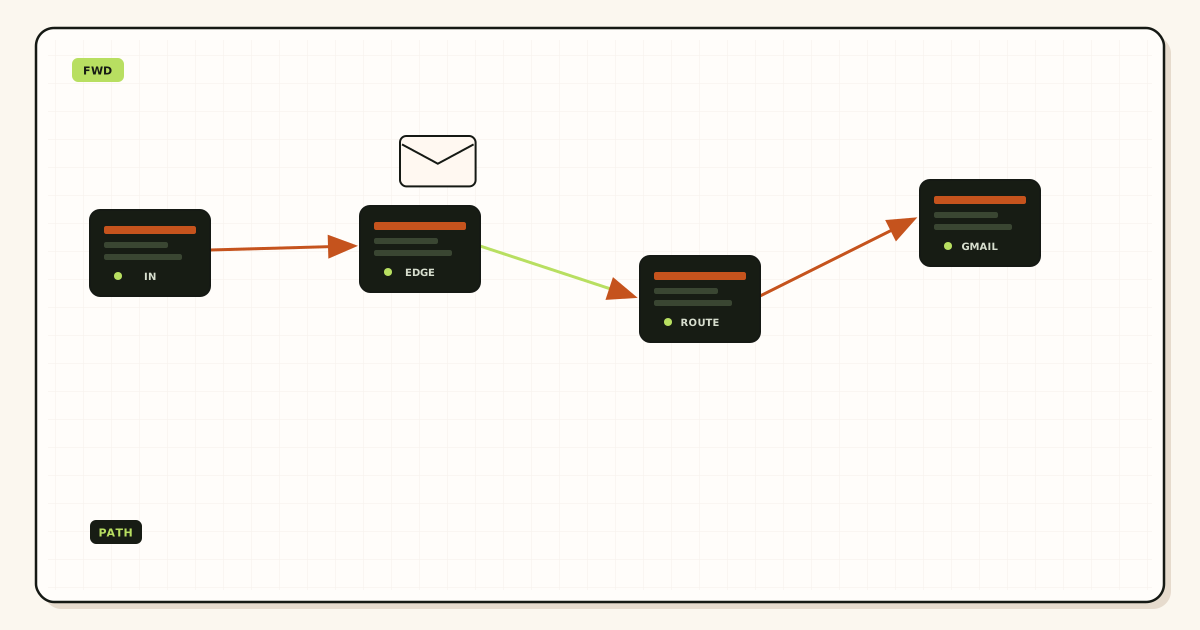
Inbound: MX, local-part, SRS envelope, intact headers, destination filter. The filter is not in MailerZ. The hop is.
Outbound paid send-as: dashboard SMTP and your published trio. Mixing a newsletter into that path creates both cap hits and filter heat. Solo is 20 send-as per hour.
Authentication-Results on the received copy describe the hop that arrived. A pass there is hygiene. It is not a Primary-tab SLA.
Leftover MX means some senders never create a MailerZ hop. Those users report “spam” because they heard nothing. Empty history plus two MX owners is the proof.
DSN text that says 5.7.1 policy is a reject, not a false positive. Do not file it here. Diagnose the SMTP reply instead.
Step-by-step setup / decision path
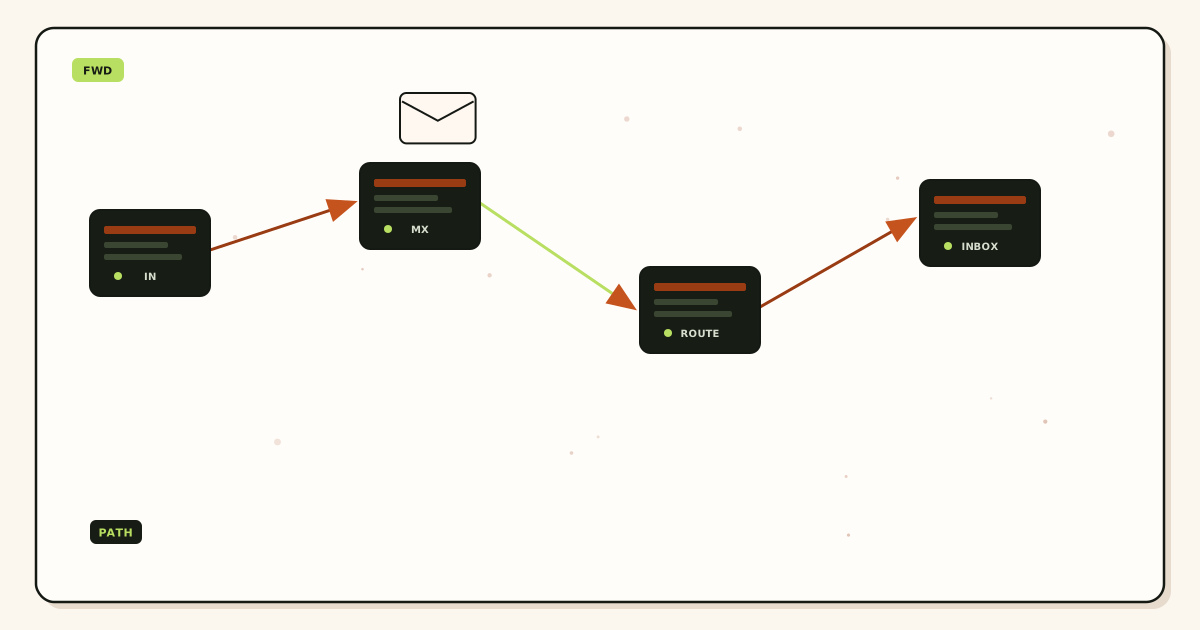
- Classify the ticket: empty history, 5xx, or 250-plus-junk. Write that first.
- Confirm exclusive MX from two resolvers. Delete leftovers. Demoting priority is not deletion.
- Confirm the alias is named and mapped. Typos look like spam complaints.
- Keep unknown recipients on HOLD unless you have a written FORWARD reason.
- Send a unique operational probe from a third mailbox. Open original. Record folder and Authentication-Results.
- Ask the destination owner to search all mail and blocked senders.
- Move bulk lists to an ESP. Keep receipts and replies on SMTP.
- Do not rewrite Header From and do not ask MailerZ for an inboxing percentage.
Write the folder result as an observation for that recipient, not as a KPI you will hit next week. Placement varies.
If you have no third mailbox, you do not have a false-positive test. Create one before you argue with a checker screenshot.
After you change catch-all, repeat the probe. FORWARD on can look like “more mail arrived” while it quietly ruins the destination.
Failure modes and proof
Checker-only go-live: junk at customers. Proof: third mailbox folder versus the badge.
Leftover MX: missing mail labeled spam. Proof: two MX owners.
Catch-all cannon: destination trained as noisy. Proof: made-up local-part still arrives.
Header rewrite elsewhere: users distrust the sender. Proof: original From changed. MailerZ does not do this.
List on reply SMTP: cap plus filter heat. Proof: volume versus Solo 20 per hour.
User block: perfect hop, still junk. Proof: destination blocked senders.
Self-send: false folder. Proof: no third party.
Unknown recipient 550 filed as spam. Proof: history names the local-part.
Promised percentage: vendor overclaim. Walk away.
Open relay “to improve inboxing”: 550 5.7.1. Opposite of helpful.
Dual MX backup: split hops. Proof: public MX two companies.
Shared inbox rule: one person’s junk button. Proof: the rule, not DNS.
MailerZ workflow and product boundary
MailerZ is custom-domain aliasing and forwarding with optional paid send-as. Secuno LLC operates mailerz.net. The app is mail.mailerz.net. Not Workspace, not IMAP, not an open relay, not a campaign ESP.
Envelope SRS only. Header From, Subject, Date, Message-ID, body, and MIME stay intact. Exclusive MX. Hold unknown on Free. Copy SMTP host, port, and TLS or STARTTLS from the dashboard when you send. Do not invent 587 or 465 as MailerZ facts.
Free: one domain, ten aliases, one seat, fourteen-day store, send-as disabled, SMTP and API disabled. Solo forty dollars a year, twenty-five aliases, ninety-day store, 2,500 outgoing, 20 send-as per hour. Starter eight monthly or eighty yearly. Business nineteen or one hundred ninety. Agency thirty-nine or three hundred ninety. Quote the pricing page. No SOC 2, ISO, HIPAA, SLA, or inboxing percentage.
Use hop history in the store window to separate rejects from folders. Free keeps fourteen days. Paid keeps ninety. That clock is part of false-positive work.
Cost, alternatives, and trade-offs
Seed-list tools cost money and still sample. They are not a guarantee. A Workspace seat does not buy Gmail’s filter for other people.
Catch-all FORWARD looks cheap until the destination owner spends hours in junk. Hold is cheaper even when a paid plan allows FORWARD.
Agencies should price “hop correct” and “folder observed” as different lines. Do not sell a number MailerZ will not print.
Doing nothing except arguing with customers costs more than one third-mailbox test.
An ESP is the right spend for bulk lists. It is the wrong spend if you only needed aliases.
Buying a second forwarder to “improve inboxing” creates leftover MX. You pay twice for worse mail.
Time on user filters is cheaper than time on DNS when history already shows 250.
If a vendor sells a false-positive SLA on forwarding, they are selling a folder they cannot see.
Operational depth for forwarded email false positives
Most false-positive arguments start in the wrong inbox. The person who filed the ticket is often not the destination owner. They forwarded a screenshot of junk. They did not search all mail. They did not look at blocked senders. Your first operational move is to name the mailbox that actually received the hop. If you cannot name it, you are not debugging forwarding. You are debugging a rumor.
Write the hop time in UTC next to the local time the user quoted. Store windows expire. A complaint from “last week” on Free may already be gone. Ask for a fresh uniquely titled message. People hate that request. It is still cheaper than republishing MX from a feeling.
When the hop is 250 and the folder is junk, stop talking about SPF in the ticket. SPF already did its job on that hop or it did not—Authentication-Results will say. Additional includes will not flip a user filter. Additional MX owners will make the next complaint worse.
Shared team inboxes accumulate silent rules. Someone created a rule for a noisy vendor last year. The vendor is now a customer. The rule still files them. That is a false positive with a human author. History will look perfect. Ask for the rules list before you touch DNS.
Catch-all FORWARD is not a false-positive reducer. It is a false-positive factory. Dictionary local-parts arrive. The destination learns that this mailbox eats noise. Later, a real invoice looks like the same noise. Hold unknown. Create named aliases when a local-part proves it is real.
If you send-as, keep receipts and password resets on SMTP and keep newsletters on an ESP. Mixed streams are how filters decide you are a campaign. Solo’s 20 send-as per hour is a product cap, not a dare. Bursting after a cap looks automated.
Agencies should put “folder versus hop” on the invoice as two lines. Clients who buy a hop fix and then demand Primary are buying a folder nobody outside Gmail or Outlook can sell. Say that in the kickoff, not in the postmortem.
Portal senders that cannot follow a forward will keep looking like false positives. They are sender limits. Offer a dedicated mailbox for that one portal. Do not weaken HOLD for a bank template from 2004.
Header From intact is part of reducing distrust, which users also call spam. If a previous forwarder rewrote From, users learned to ignore the domain. After you move to MailerZ, tell them the visible sender is the real person again. That education is operational work.
Do not publish an inboxing target in Slack. MailerZ will not back it. A third-mailbox observation is allowed. A percentage is not.
If leadership wants a dashboard, give them hop success and exclusive MX, not a fake Primary rate. Those two numbers are yours. The folder is not.
Repeat the probe after any catch-all change, any destination change, and any leftover MX deletion. False positives come back when someone “improves” DNS on a Monday.
False positive usually means dest classify, not a MailerZ reject
How to reduce false positives in forwarded email starts by naming the hop. Dest 250 plus spam is classify. Empty history is leftover MX or hold, not a false positive. 5xx is a reject. Do not “fix spam” by adding a second MX. Exclusive MailerZ MX. Delete leftovers. Two views. Foreign probe. Header From intact — we do not rewrite it. Envelope SRS only. Forwarders that rewrite Header From break dest auth and raise false positives. Cite dest vendor spam docs. We do not promise Primary. Confirm /pricing. Caps are not an inbox SLA.
Hold unknowns. Catch-all fan-out trains spam buttons on two dests. Named aliases only on everyday production. Do not blast lists through reply SMTP. Volume looks like bulk. Free cannot finish send-as. Unauthorized send is 550.
One dest you control. Dest filters that forward “everything from this domain” back to the alias loop and look like a spam storm. Disable the circular rule. Search dest junk before you rebuild aliases. Self-send hides both auth and folders.
SPF, DKIM, and DMARC authenticate send-as. They do not encrypt and they do not command Primary. One SPF. Green checkers are publication, not placement. MailerZ is not HIPAA, not SOC 2. Point questionnaires at /security.
A “spam incident” that was leftover MX
History empty. Dest empty. Operator filed false positive. Public MX still Google. Customers never reached this layer. Delete leftover. Probe. Then, if dest 250 and junk, record the folder. Related: troubleshooting, delivery recovery, features. RFC 7489 is alignment, not a tab.
Close
Print MX, history, dest folder. Name leftover, hold, reject, or classify. Change one fact. New subject. Neighbor aliases probed. Start free on a breakable domain. Sign in if the zone already lives here. That is how to reduce false positives in forwarded email without ripping a working hop.
Agencies keep dest filter docs per client. Do not merge classify into a leftover ticket.
Filters you can change versus ones you cannot
You can hold unknowns, name aliases, keep Header From intact, keep exclusive MX, keep volume operational, keep one dest. You cannot command Gmail Primary. You cannot make a green checker a warranty. You cannot encrypt the dest store from this hop. Record the folder. Cite dest docs. Confirm /pricing for caps only.
If dest 250 and junk after a leftover delete, wait a few operational messages before ripping aliases. First mail after a cut often tabs. Related: troubleshooting, features, security. RFC 7489.
Close
Name leftover, hold, reject, or classify. One change. New subject. Start free on a breakable domain. Sign in if the zone already lives here. That is how to reduce false positives in forwarded email.
Do not add backup MX. Do not catch-all. Do not rewrite bodies. We will not rewrite the body. Envelope SRS only.
Two dests, two folders
Fan-out means two classify paths. One dest Primary, one dest junk, is not a MailerZ coin flip. Search both. Prefer one dest until staff can handle two. Hold unknowns so harvest does not train both. Confirm /pricing. Related: aliases and catch-all, troubleshooting, features.
Start free on a breakable domain. Sign in if the zone already lives here. That is how to reduce false positives in forwarded email when two dests disagree.
First week after a cut
Expect a dest tab on the first operational messages. Do not rip MX. Keep exclusive MailerZ. Keep Header From intact. Keep volume low. Record folders. If empty history appears, you have leftover or hold, not classify. Confirm /pricing. That is how to reduce false positives in forwarded email in week one without folklore.
Auth-Results on original
If dest original shows dkim=fail after you swore MailerZ does not rewrite, another hop rewrote or leftover MX took the path. Print MX. Print Authentication-Results. Do not add a second SPF to “look greener.” Two v=spf1 records permerror and do not move Primary. Confirm /pricing. That extra fact is how to reduce false positives in forwarded email when the checker was green and the folder was junk.
If Authentication-Results shows pass and the folder is still junk, you have dest classify, not a rewrite. Keep exclusive MX. Keep Header From intact. Keep volume operational. Record the folder. Do not rip aliases. We do not promise Primary. Caps are not an inbox SLA. Search dest junk before you open a leftover-MX ticket. Empty history plus leftover MX is hop one, not a false positive, and deleting the leftover is the one change. Wait two public views, then send a new unique subject from a mailbox that is not the destination.
Consumer Gmail versus a Workspace destination
How to reduce false positives in forwarded email changes when the destination is a consumer Gmail account versus a Google Workspace mailbox the company administers. Consumer Gmail gives you user filters, spam buttons, and tabs. Workspace adds org-level routing, compliance labels, and an admin who can quarantine mail the user never sees. Ask which store you mapped before you tell someone to click Not spam. If the admin quarantine ate the copy, the user screenshot of an empty inbox is not a MailerZ reject.
Outlook.com and Microsoft 365 split the same way. A personal Outlook destination has junk the user can search. A tenant can hold mail in a policy quarantine the user cannot open. History that shows dest 250 plus an empty user inbox is often that quarantine. Get the admin to search. Do not add a second MX. Do not enable catch-all Forward to “make sure it arrives.” That trains two junk buttons and does not open a policy folder.
Record the destination product name in the ticket: consumer Gmail, Workspace, Outlook.com, or Microsoft 365. Then record the folder: Primary, Updates, junk, quarantine, or missing. Those two words stop leftover-MX folklore. Exclusive MailerZ MX still comes first. Header From stays the original sender. Envelope SRS only. Confirm pricing for hop store windows, not for a Primary rate. Related: troubleshooting and delivery recovery.
Shared team inboxes accumulate silent rules in both products. A rule from last year still files a vendor that is now a customer. History looks perfect. Ask for the rules list before you touch DNS. Then send a new unique subject from an unrelated provider. Self-send still lies.
FAQ
- What is the safest way to handle forwarded email false positives?
- Prove the hop first. If history is 250 and the folder is junk, use the receiver not-spam tools and user filters. If history is 5xx, you do not have a false positive, you have a reject. Keep Header From intact. Hold unknown. Do not enable catch-all FORWARD to hide misses. MailerZ stores hops so you can tell the two apart.
- Does this require a new mailbox?
- No. False positives are a destination filter decision or a misread hop. A new IMAP seat does not teach Gmail to trust your alias. MailerZ is Mail Box portal webmail, not IMAP.
- Will it work with Gmail or Outlook?
- Both apply their own junk and tab rules after accept. A pass can still be junk. Self-send hides the hop. Use a third mailbox.
- What DNS records are involved?
- Exclusive MX so the hop you read is the hop that happened. One SPF if you send-as. DMARC alignment cares about Header From. Leftover MX creates missing mail that people mislabel as spam.
- What should I test before production?
- Send a uniquely titled operational message from an unrelated provider to a named alias. Open original. Record folder and Authentication-Results. Repeat after any catch-all change.
Key takeaways
- Classify hop versus folder before you touch DNS.
- Exclusive MX and named aliases prevent fake spam tickets.
- Hold unknown. Catch-all FORWARD trains junk.
- Header From intact plus envelope SRS is the forwarding-safe pair.
- Third mailbox proof. Self-send lies.
- No inboxing percentage. Filters live at the receiver.
- Split lists from operational SMTP.
- History in the store window is how you stop folklore.
Conclusion
Reduce forwarded email false positives by telling the truth about the hop. Fix leftover MX and unknown recipients. Teach the destination when the hop already succeeded.
Use MailerZ for aliases, HOLD defaults, and readable history. Use the receiver’s tools for folders. Use an ESP for lists. Do not confuse the three.